The Sum and the Parts
Veranika Khatskevich observes—organic bodies, nature, and the human world: outlines of clouds, the surface of our skin, the texture of tree bark, and the structure of lichen. She extracts patterns from her observations, as well as recurring manifestations of nature; as a formalized means of expression, they allow her to interrogate the structures underpinning everything that exists.
What is nature, where does it begin, and how is it inscribed in the human world? Beginning with these questions, Khatskevich abstracts her observations into templates. This form of reduction is also found in research, where natural blueprints are used to serve technical purposes or commercial interests. The abstract and stylized copies in Khatskevich’s work, however, are always legible as imitations. They are collaged, superimposed, and merge together. The work thus becomes both a cipher and translation of the same thing—an image and a reproduction of nature in one.
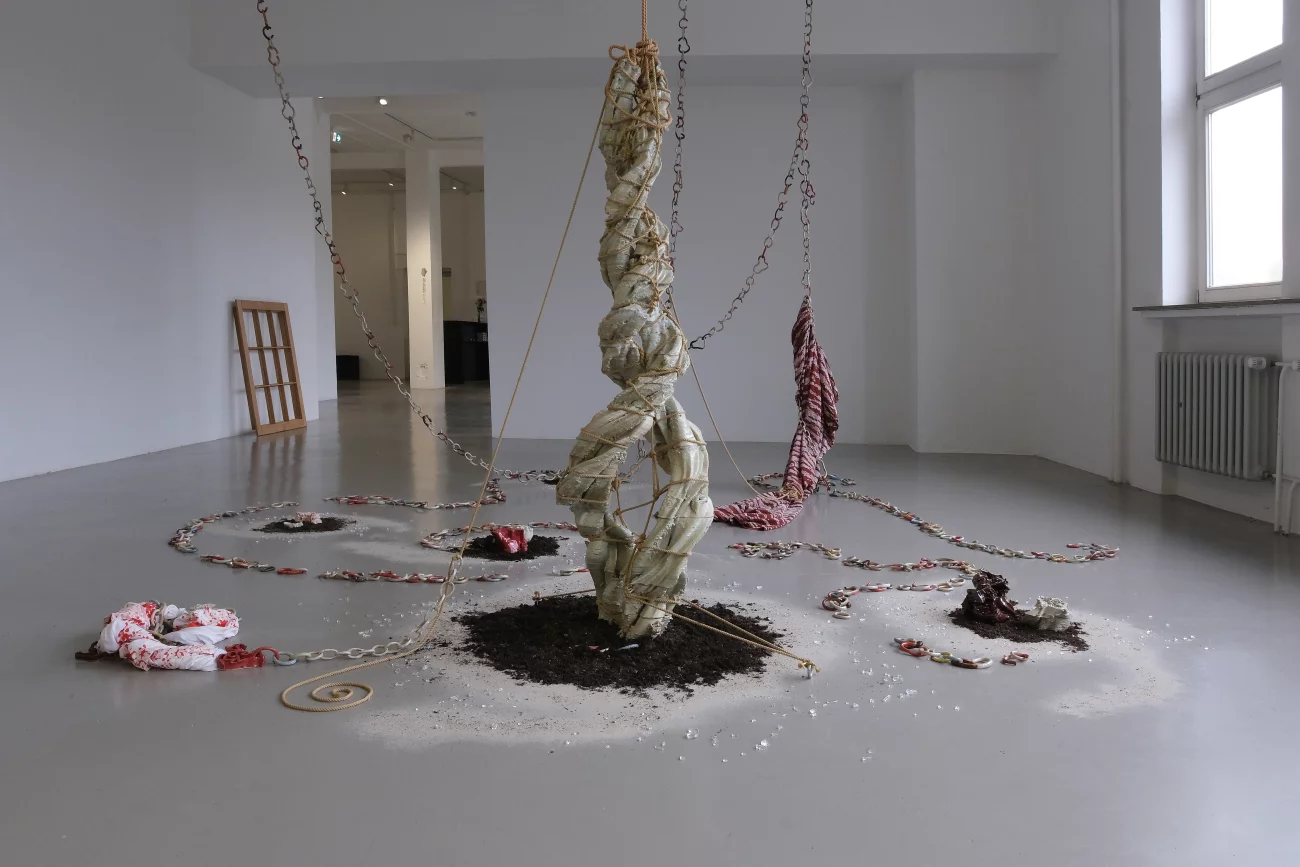
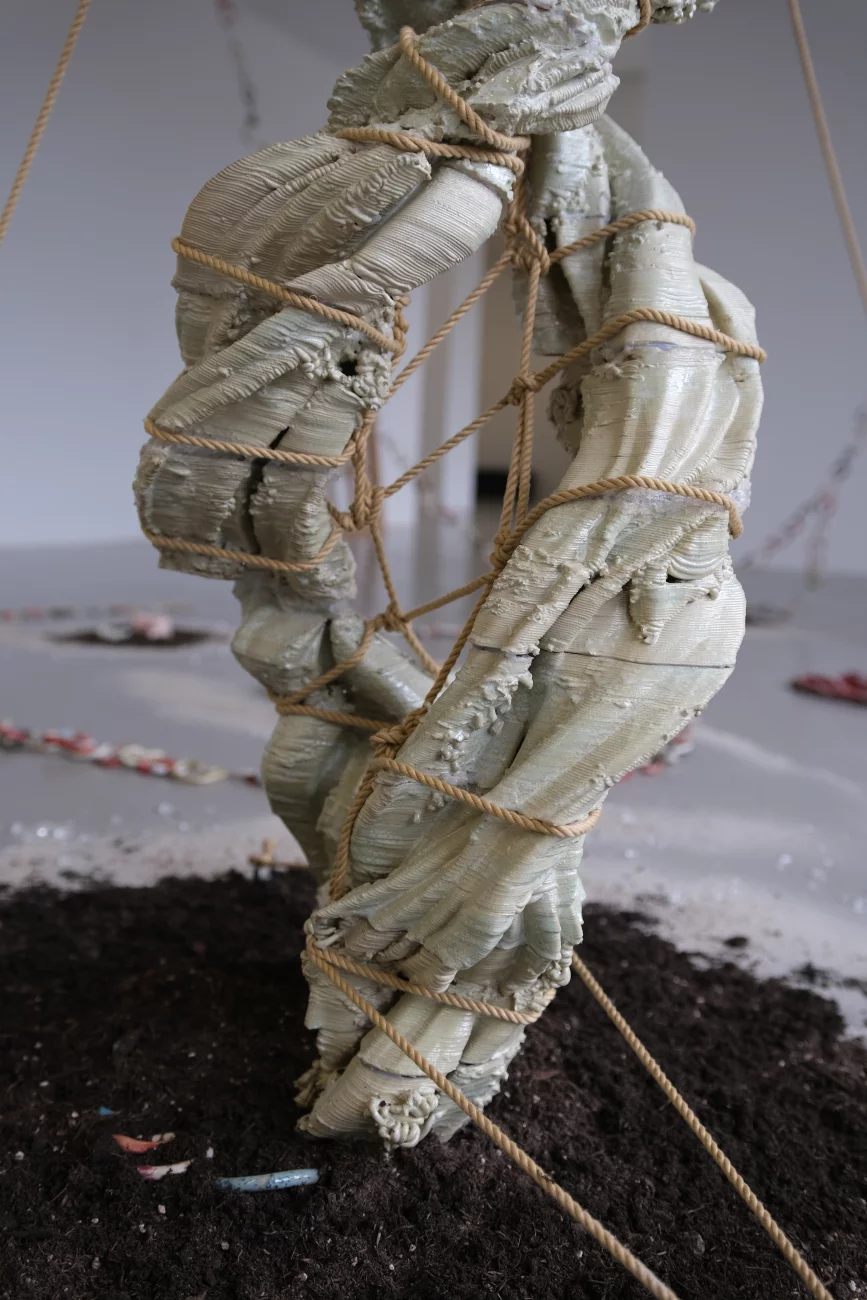
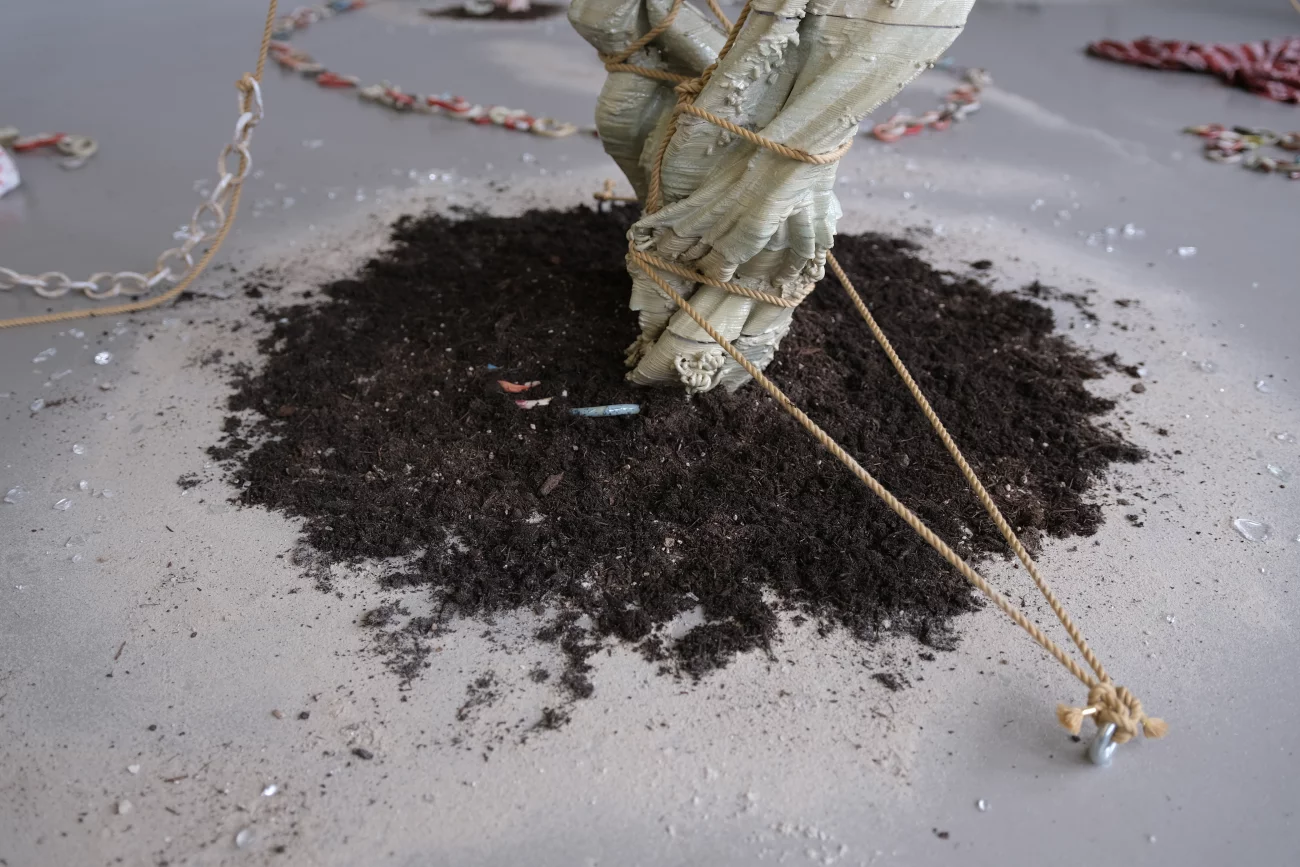
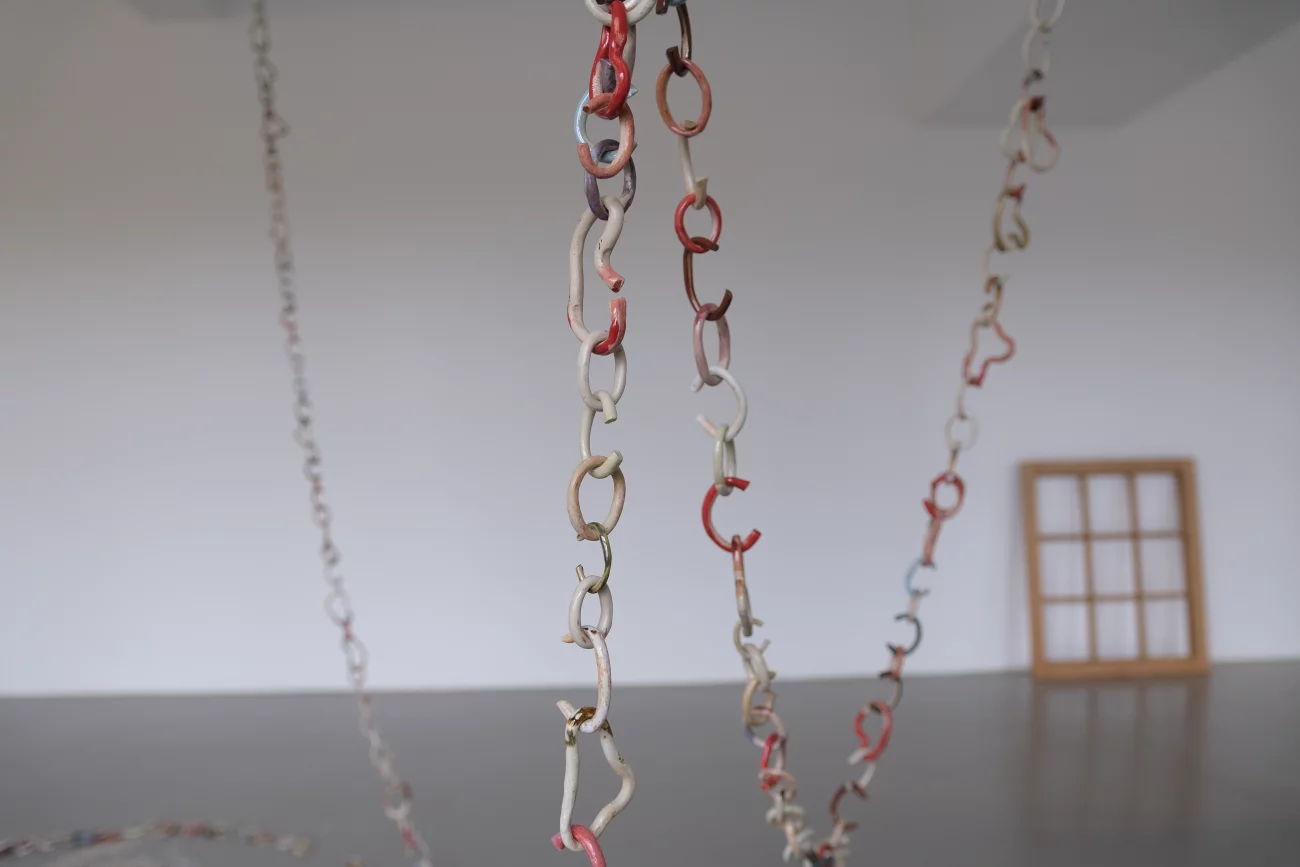
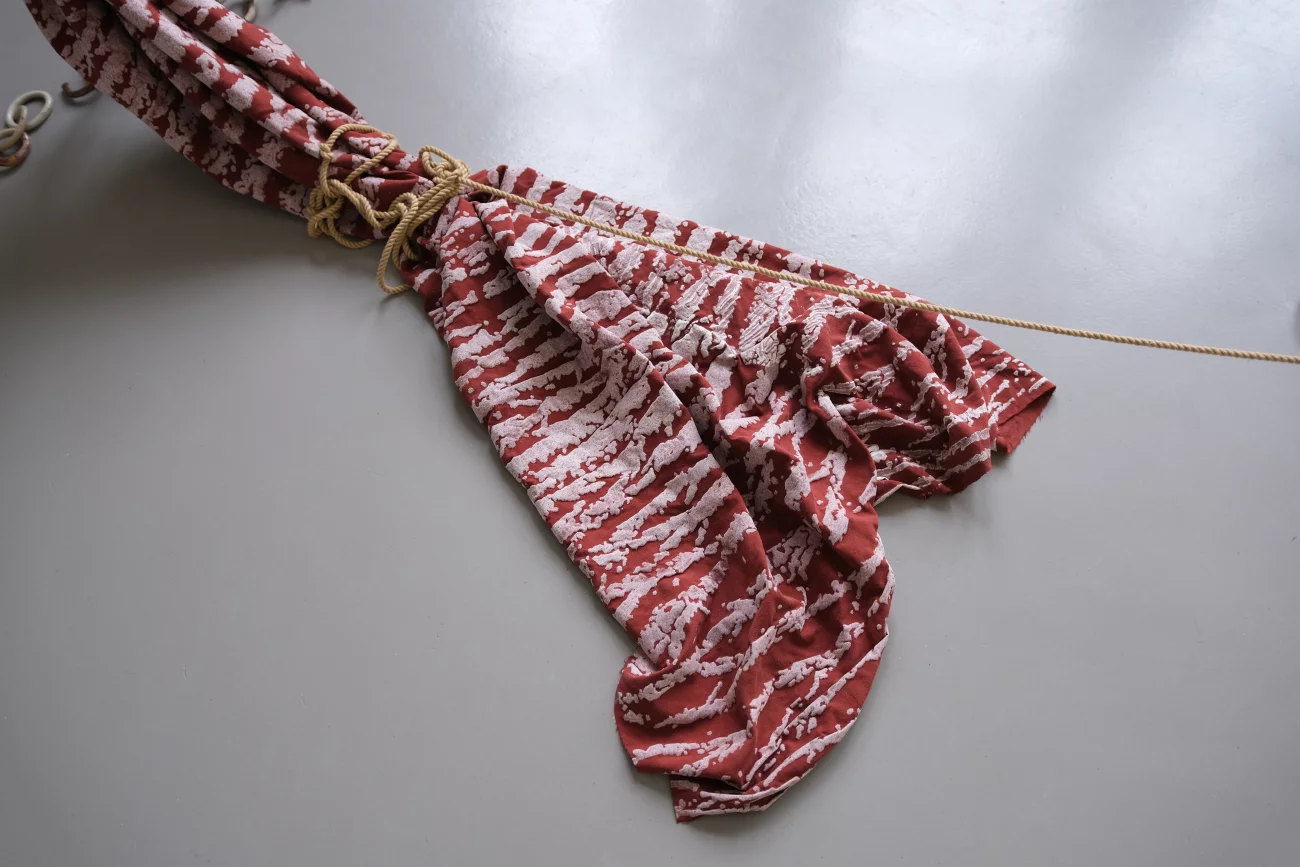
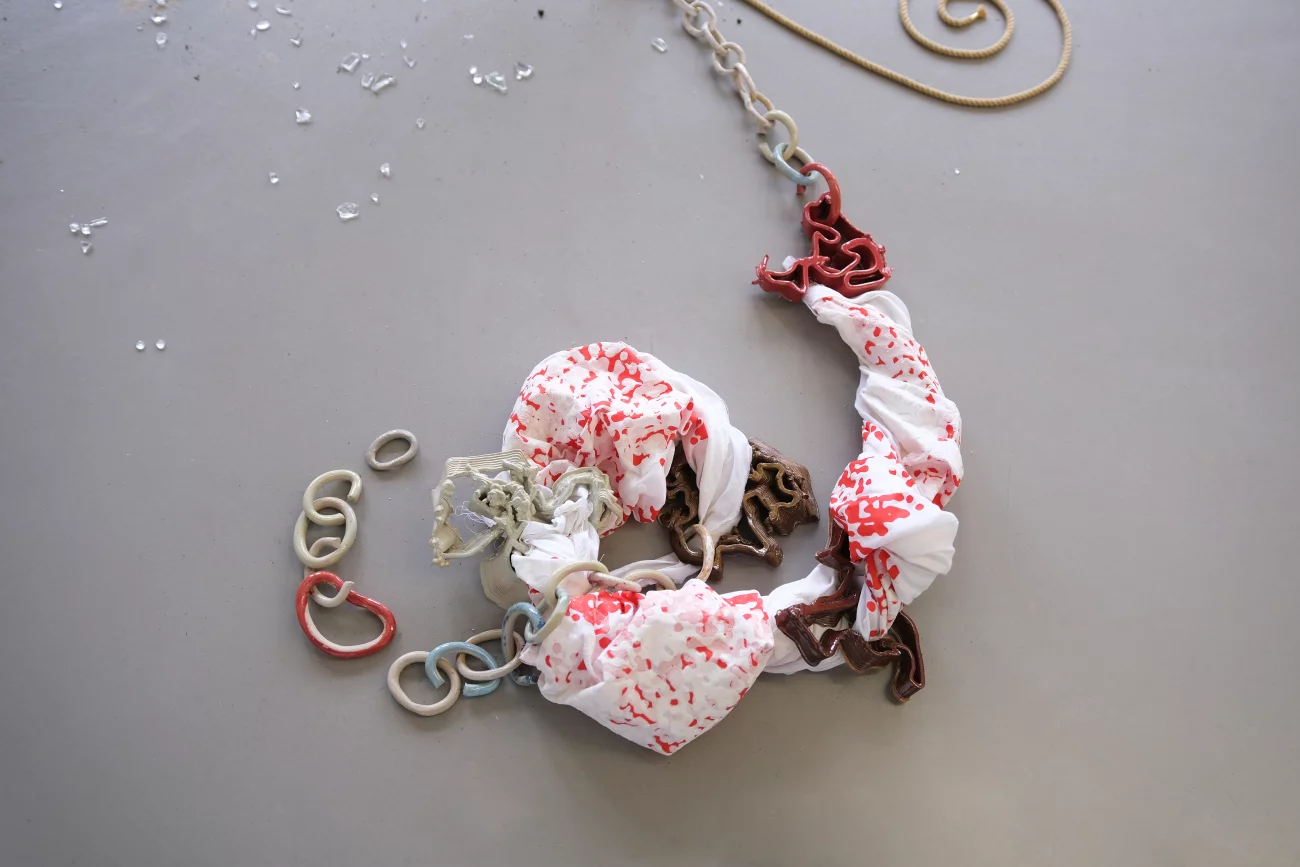
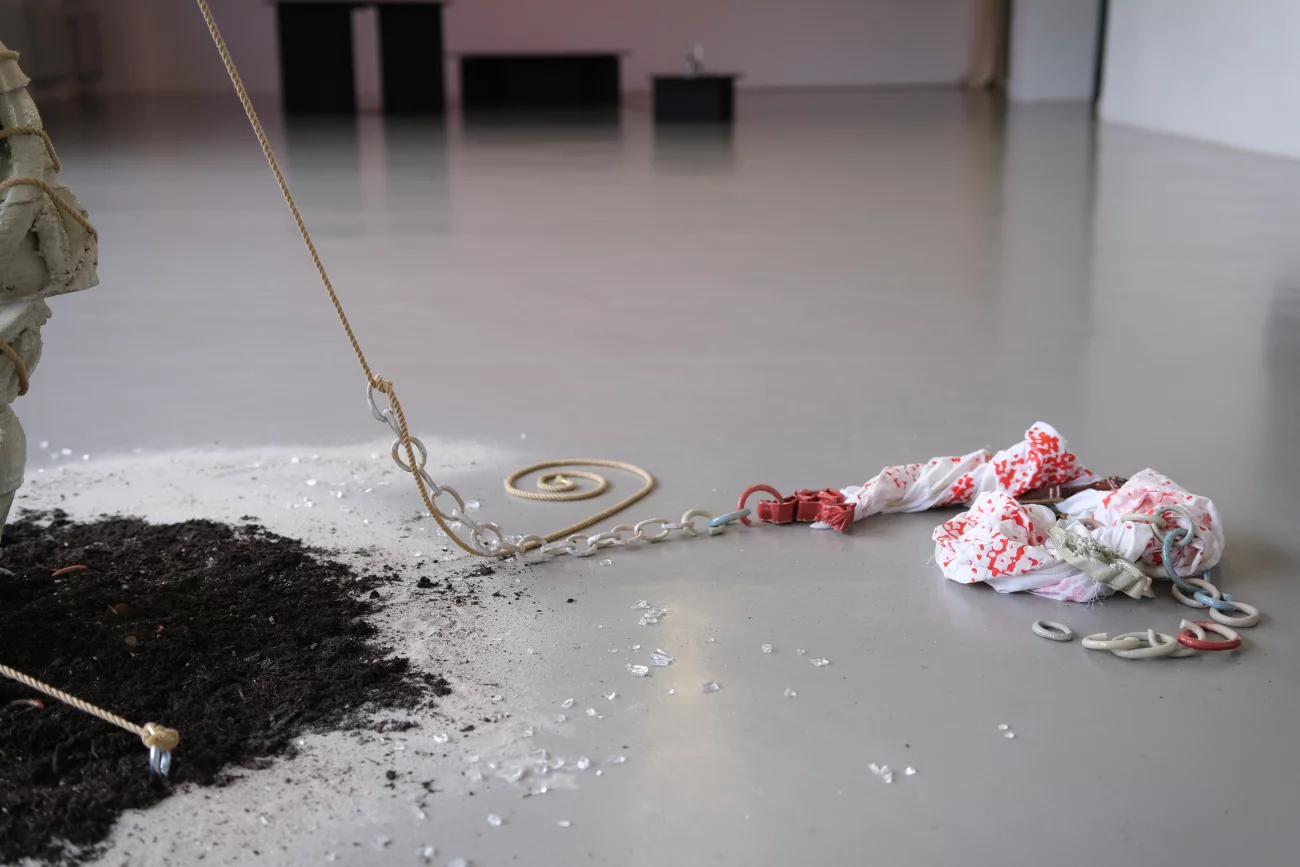
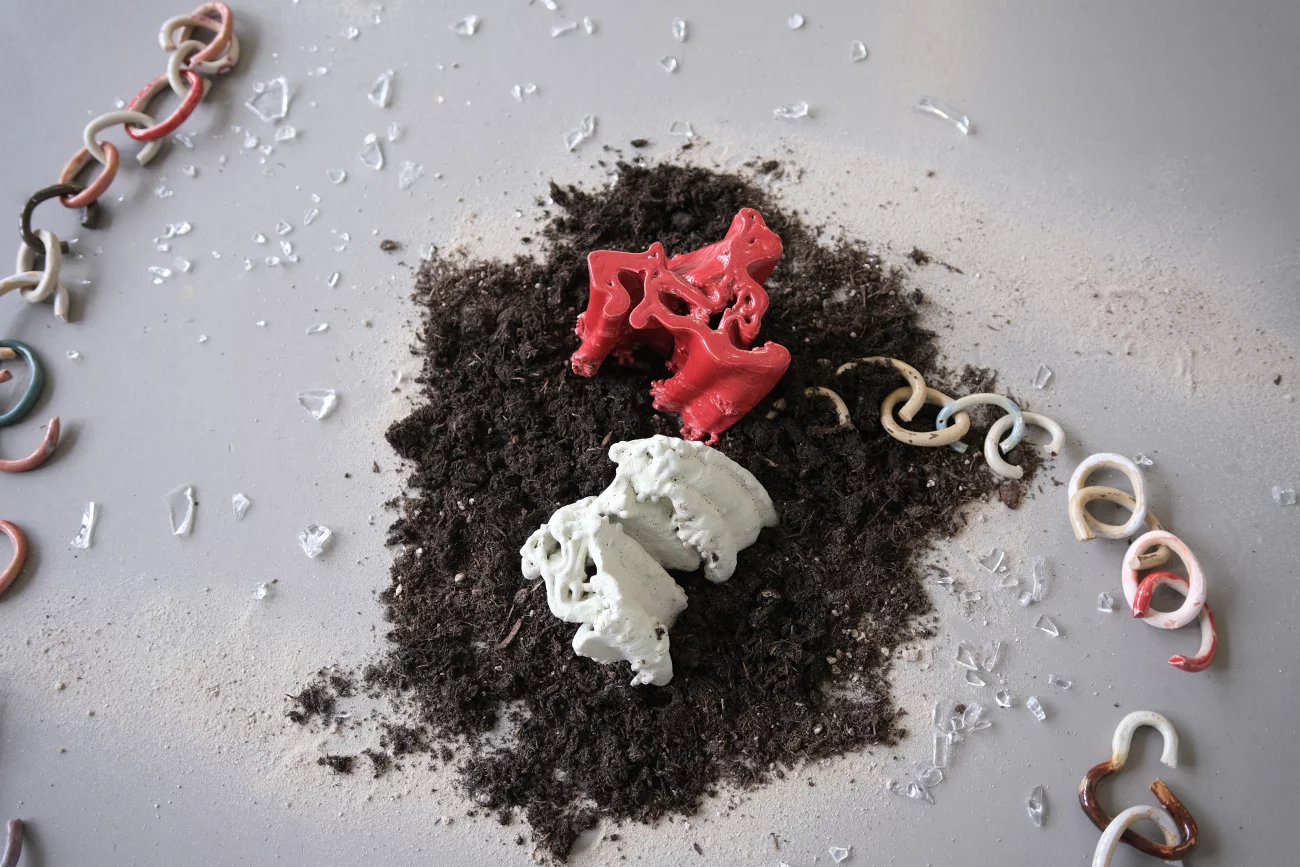
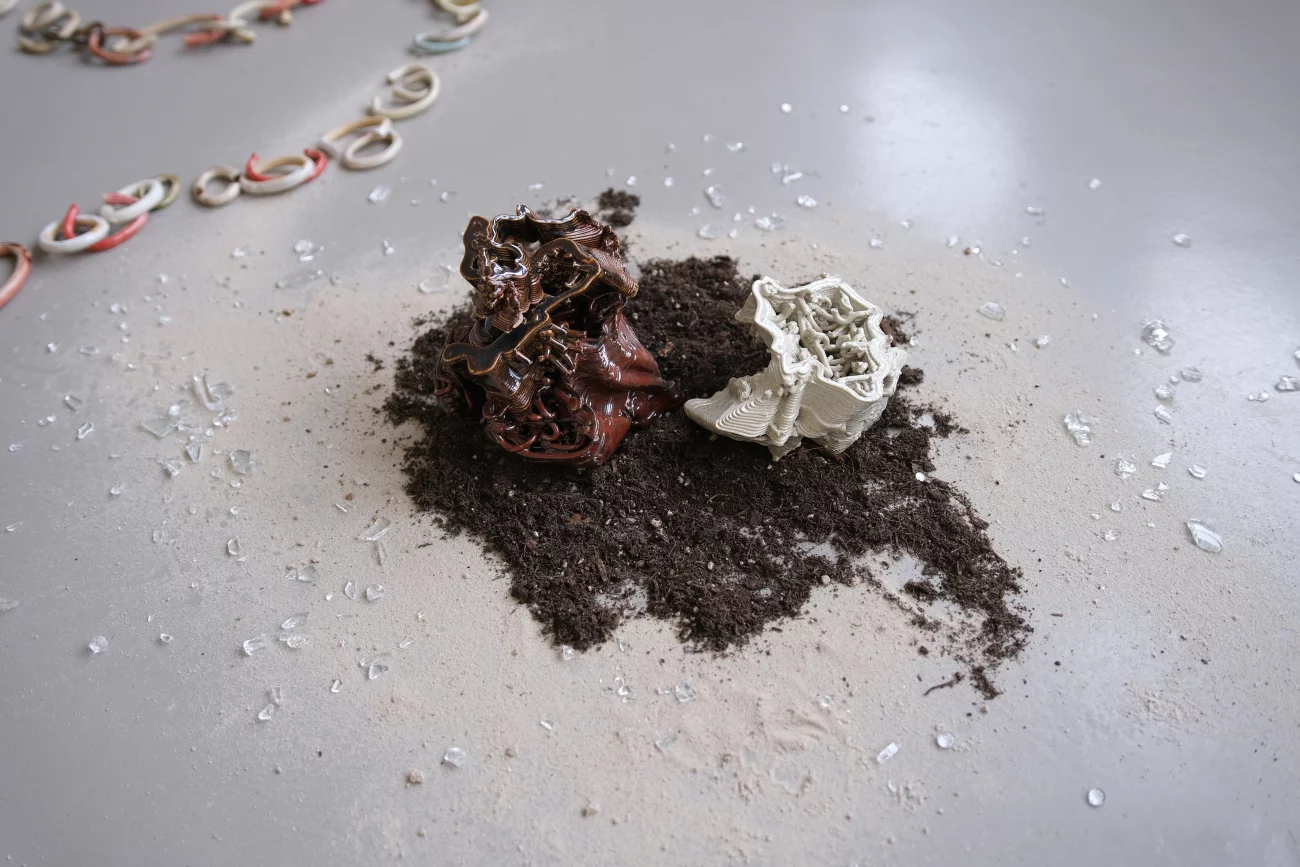
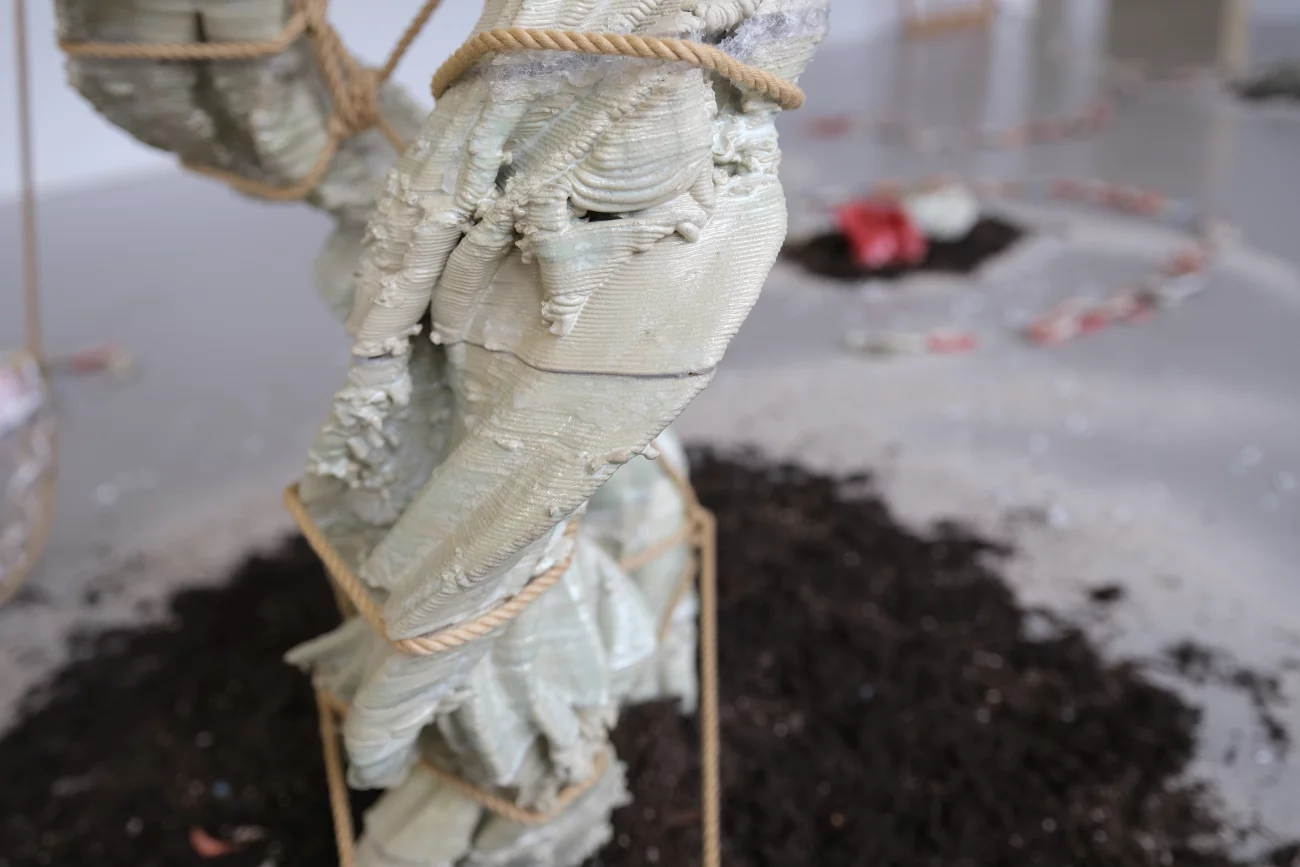
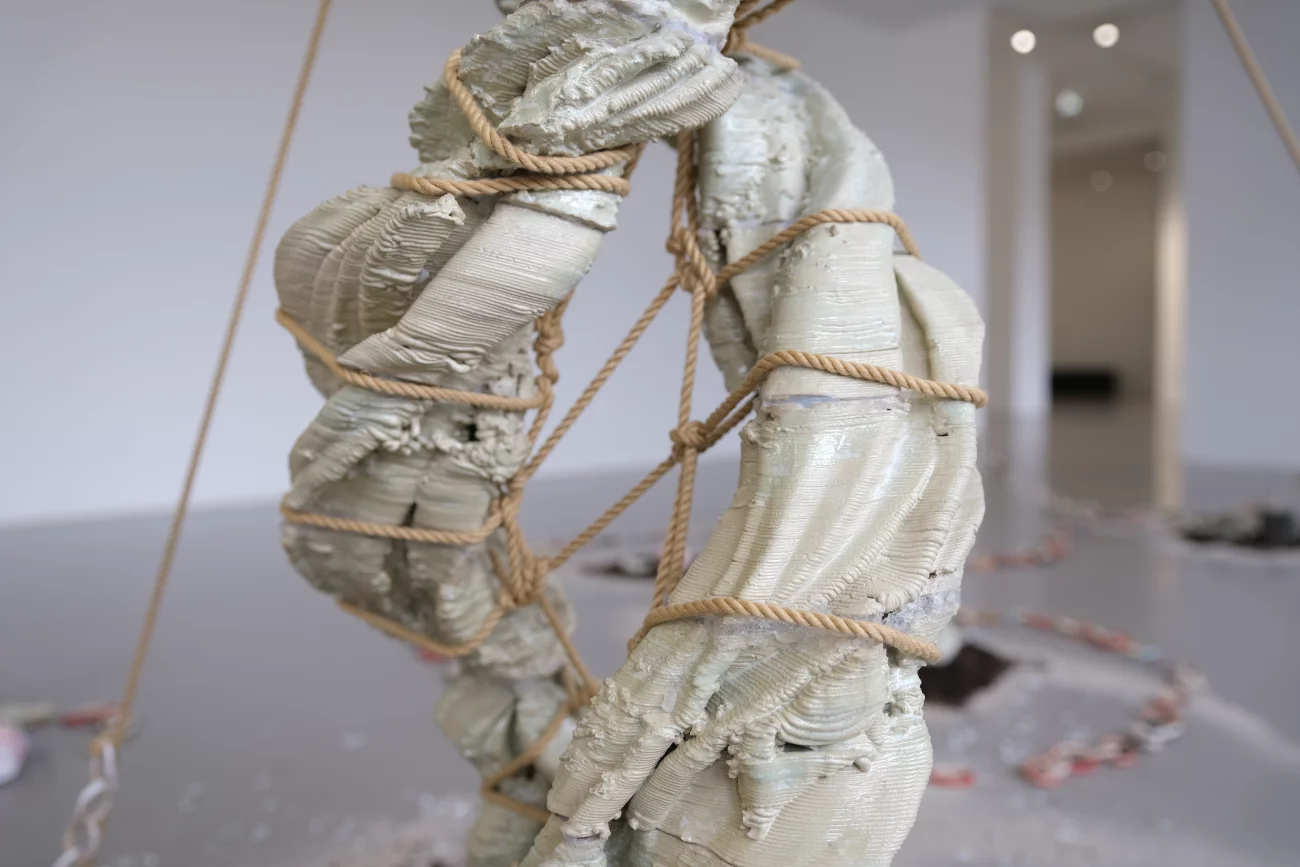
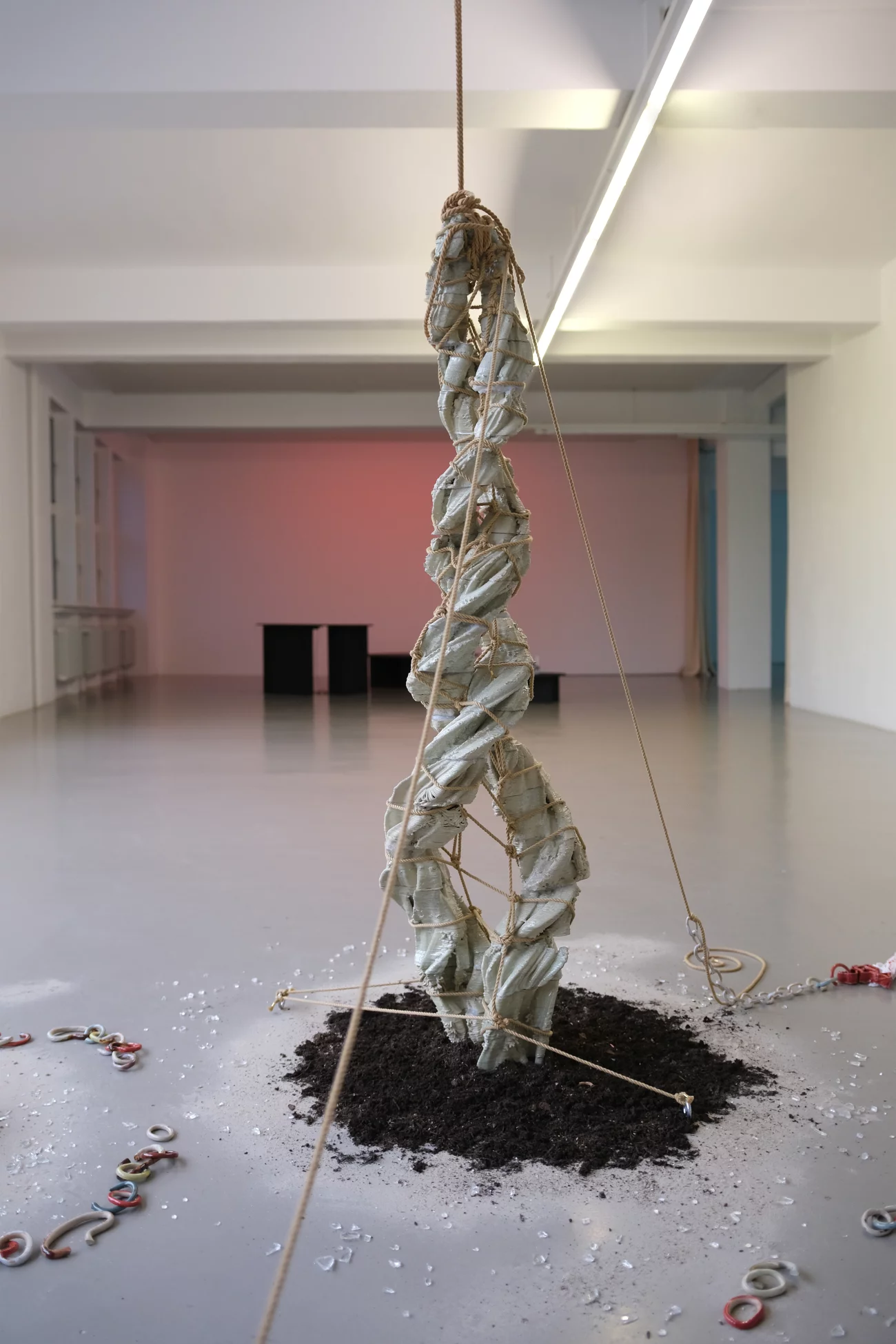
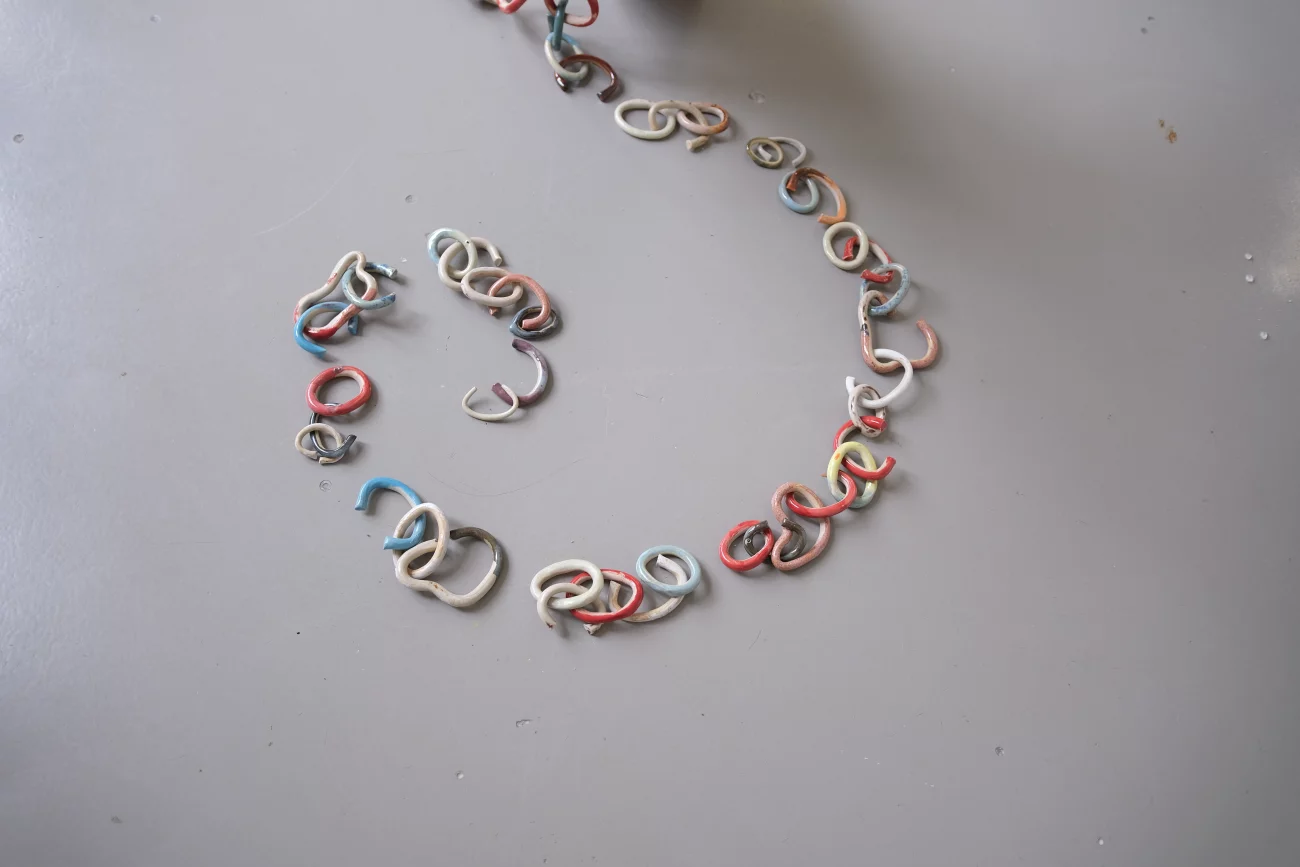
In the installation The Coldest Sound, the viewer enters a place that draws on the structural principles of nature, embracing and continuing them. They encounter chains hanging from the ceiling and spread throughout the room. Fabrics printed with patterns sprawl out like bodies. Piles of earth settle on the floor like sediments, accumulating first into sand and then into glass. Rising in the midst of this landscape and growing out of the same earth is a ceramic structure. Using a machine printing process, Khatskevich shapes clay—an ancient and natural raw material—into an artificial reproduction of one of the most fundamental biological forms: the double helix. The surface of the sculpture becomes a technical facade, reflecting the human appropriation of nature. While the free-standing spiral is trussed and held by ropes, smaller, individual pieces can be found around it like building blocks.
For the most part, nature is associated exclusively with the natural environment. However, in the context of the highly digitalized world constructed by humans, this work emphasizes that everything made by humans is a new form of nature. Khatskevich views this “new nature” as a simplified and abstracted extension of the complex, organic, original nature.
Although the digital world is not formally addressed in this work, aspects of it can be found in the working processes and materials. The digital and the virtual reflect and distort everything human and natural to create an asymmetrically symmetrical reality. The installation thus offers the viewer the opportunity to experience being a part of the totality of an abstract reality. Like nature, this can only be understood through experience and observation.
The structure that is rendered tangible in Khatskevich’s composition reveals supposed symmetries, but these are ruptured in the same instant. In this landscape, the process of transforming earth into glass seems causal, even natural. Yet the alchemical intervention of humankind is always a violent albeit creative act—a procedure that is both imitation and alienation. The result is not only a material connection, but an intertwining and overlapping of metaphorical and causal interrelationships within the work’s layers of meaning.
The motif of chains and linkages runs through the installation, creating cross-connections through material, visual, and processual combinations. Individual links unite to form a chain—multiple components create a comprehensive structure. Khatskevich’s work is more than the sum of its individual parts. It cannot be understood as a fixed point, but must be conceived of as an ongoing process in which the human and the natural interact with each other—continuous outpourings, progression, and reconciliation.
Khatskevich uses these natural forms and patterns to devise a language that is universal and timeless, both as a whole and in terms of its individual structural elements. The utilization of recurring and overlapping forms establishes an approach that exists beyond the linear passage of time. There is an interplay between repetition and transformation, which also manifests itself in Khatskevich’s spiral. The concept of time is embodied and reflected. It can be experienced in the installation as an excerpt of the timeless essence of nature.
For the original text in German and English, see the PDF